


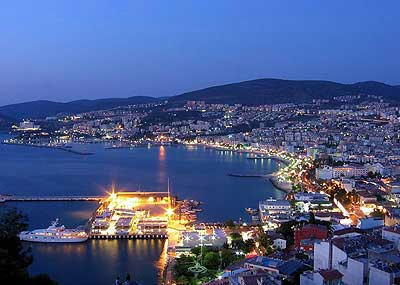
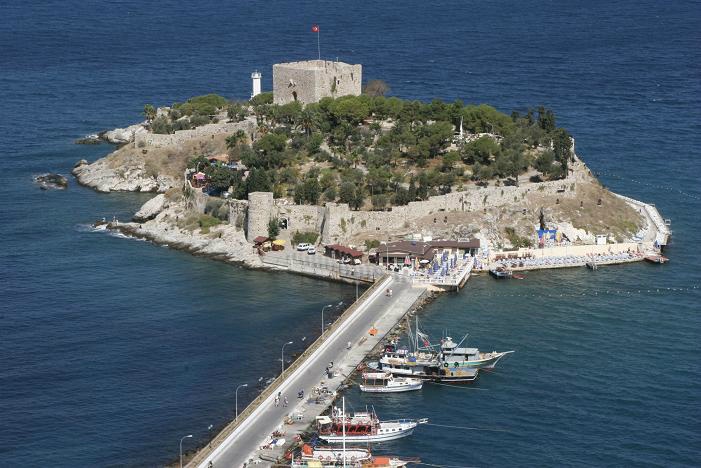
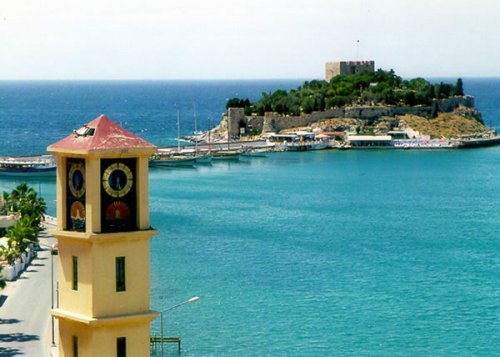
The name comes from 'kuş' (bird) and 'ada' (island) as the peninsula has the shape of a bird's head (as seen from the sea)It was known as Ephesus Neopolis (Ἔφεσος Νεόπολις) during the Byzantine are, and later as Scala Nova or Scala Nuova under the Genovese and Venetians Kuş-Adası was adopted in its place at the beginning of the 20th century. Today, citizens of Kuşadası often shorten the name to Ada.
The area has been a centre of art and culture since the earliest times and has been settled by many civilizations since being founded by the Leleges people in 3000 BC. Later settlers include the Aeolians in the 11th century BC and Ionians in the 9th century. Originally seamen and traders the Ionians built a number of settlements on this coast including Neopolis.
An outpost of Ephesus in ancient Ionia known as Pygela (Πύγελα), the area between the Big Büyük Menderes (Meander) and Gediz (Hermos) rivers, the original Neopolis is thought to have been founded on the nearby point of Yılancı Burnu. Later settlements were probably built on the hillside of Pilavtepe, in the district called Andızkulesi today. Kuşadası was a minor port frequented by vessels trading along the Aegean coast. In antiquity it was overshadowed by Ephesus, until Ephesus' harbor silted up. From the 7th century BC onwards the coast was ruled by Lydians from their capital at Sardis, then from 546 BC the Persians, and from 334 BC along with all of Anatolia the coast was conquered by Alexander the Great. From then onwards the coastal cities in Anatolia were a centre of Helenistic culture.
The Roman Emprie took possession of the coast in the 2nd century BC and made it their provincial capital and in the early years of Christianty. St John the Evangelist and (according to Roman Catholic sacred tradition) Mary (mother of Jesus) both came to live in the area, which in the Christian era became known as "Ania". Later the port was a haven for pirates. As Byzantine, Venetian and Genoese shippers began to trade along the coast the port was re-founded (as Scala Nuova or Scala Nova - "new port"), a garrison was placed on the island, and the town centre moved from the hillside to the coast.
From 1086 the area came under Turkish control and the Aegean ports became the final destination of caravan routes to the Orient. However this arrangement was overthrown by the Crusades and the coast again came under Byzantine control until 1280 when first the Mentese and then the Aydin Anatolian Beyliks took control. Kuşadası was brought into the Ottoman Empire by Mehmet I in 1413. The Ottomans built the city walls and the Caravanserai that still stand today. In 1834 the castle and garrison on the island was rebuilt and expanded, becoming the focus of the town, to the extent that people began to refer to the whole town as Kuşadası (bird island). However in the 19th century, trade declined in favor of Izmir with the opening of the Izmir – Selcuk – Aydın railway, as Kuşadası had no rail connection.
During the Turkish War of Independence Kuşadası was occupied from 1919-1922 first by Italian (till 1921), then by Greek troops. The Turkish troops won control of the city on September 7, 1922. Under the Turkish Republic the Greek population was exchanged for Turkish people as part of the Poplation exchange between Greece and Turkey in 1922. It was a district in Izmir Province until 1954 and become the district of Aydın Province. Until the first holiday apartments were built here in the 1970s Kuşadası was a fruit-growing rural district, it then grew into a small resort town with holiday flats. These were built as housing co-operatives, membership sold to families in Ankara, İzmir, Denizli and other Turkish cities. From the mid 1980s Kuşadası grew again into the centre of mass tourism that we have today.





 Phone:+90 256 614 75 69
Phone:+90 256 612 73 87


- Member of


- Istanbul City
- Sylvester Night - a boat trip on Bosphorus
- Istanbul – Orient & Occident with Tulips Festival
- A Tale from the Story of 1001 Nights
- Ports&Excursions
- Best of Ephesus Full Day
- Biblical Ephesus, Virgin Mary Shrine & Private Mass
- Ephesus with Terrace Houses
- Trekking & Bike Tours
- Antalya- Ormana - Cappadocia - Antalya
- Bike Tours - the Turkish Silk Road
- Trekking along the dream Lycian coast with Blue Voyage
- Biblical Tours
- In The Footsteps of Saint Paul
- Seven Churches of Revelation
- St. Paul's Missionary Journey in Turkey&Greece
DETAILS

Cumhuriyet Mah. Taksim Sok.
No.11-A D. 2 09400
Kusadasi / AYDIN

- Phone : +90.256.614 75 69
- Fax : +90.256.613 10 06

 www.facebook.com/pages/Marjinal-Travel/237038239758774
 www.twitter.com/MarjinalTravel